
Distinguish language models, AI services, copilots and specialised tools by task, data access and degree of integration. Criteria such as output quality, data protection, cost, currency and integration into existing workplaces make selection transparent.

CTPM Academy · AI & Enterprise IT
AI becomes valuable when it works in the real world.
We explain clearly, meet you at your current level and develop solutions with you that genuinely improve processes, data and decisions.
Seminar search
What would you like to learn or solve?
Search for a topic, learning goal or term and find suitable seminars directly.
Seminar finder
Which seminar matches your goal?
Choose your goal or narrow the selection by search term, subject, experience, duration and learning format. Every field is optional and can be combined.
1 matching seminar
Show all learning topics
Learn which tasks generative AI can support reliably and where probabilistic output, hallucinations, bias, context limits or outdated knowledge create risk. Common failure modes are recognised, assessed and connected to appropriate checks.
Translate unclear work requests into structured prompts containing context, task, inputs, objective, quality criteria and output format. This makes requirements transparent, results easier to compare and follow-up questions more focused.
Improve prompts in controlled steps, compare variants and distinguish professional weaknesses from wording or context problems. Proven patterns are versioned, documented and made reusable for similar tasks.
Review AI output for professional accuracy, completeness, contradictions, source grounding and fitness for purpose. Checklists, challenge questions and human approval points help correct weak results deliberately.
Work on common tasks such as drafting, summarising, comparing, extracting, classifying and preliminary research. Clarify required inputs, result validation and where AI usefully supports the existing workflow.
Classify personal, confidential and business-critical information and decide what data an AI service may process. Anonymisation, permissions, provider settings, internal rules and safer alternatives are assessed through practical situations.
Apply the methods to transparent tasks, compare alternative approaches and reflect on the impact of your decisions. Exercises combine explanation, hands-on work, feedback and a transferable improvement.
Receive and use checklists, structures, examples and concise references that remain useful after the seminar. Materials are not merely distributed; they are explained and related to common application situations.
Map a real workflow with triggers, inputs, roles, decisions, handovers and outputs. Assess where AI can help, which controls are required and how a reliable pilot fits into the process chain.
Discover existing text, documents and knowledge through source structure, metadata, terminology and suitable search or retrieval approaches. Quality, currency, permissions and the limits of a RAG or knowledge solution are made explicit.
Place data objects, databases, interfaces, ETL pipelines and enterprise software into one coherent solution view. System boundaries, data flows, responsibilities, error paths and operational requirements are considered.
Define measurable expectations, validation rules and approval points for inputs, processing and outputs. Sampling, logging, escalation and human accountability create controlled use instead of blind trust.
Work on realistic cases from requirements engineering, business analysis, project management, development, architecture, quality and testing. Roles, system dependencies, trade-offs and technical constraints are explicitly included.
Develop prompt structures, analysis templates and workflow patterns that can be reused with clear inputs, checks and ownership. Versioning and adaptation prevent templates from becoming uncontrolled one-off solutions.
Create a tangible result for your own work, such as a prompt template, analysis, checklist, process sketch or pilot description. Next steps, ownership and success criteria make the transfer actionable.
Before an in-house session, audience, knowledge level, systems, assignment and desired outcomes are aligned. Examples, depth, exercises and transfer tasks are adapted to the actual organisational context.
For regulated, safety-critical or highly specialised content, the roles and responsibilities of a dual-instructor team are defined. CTPM covers AI, IT, data, architecture and methodology; the sector expert adds processes, terminology and binding requirements.
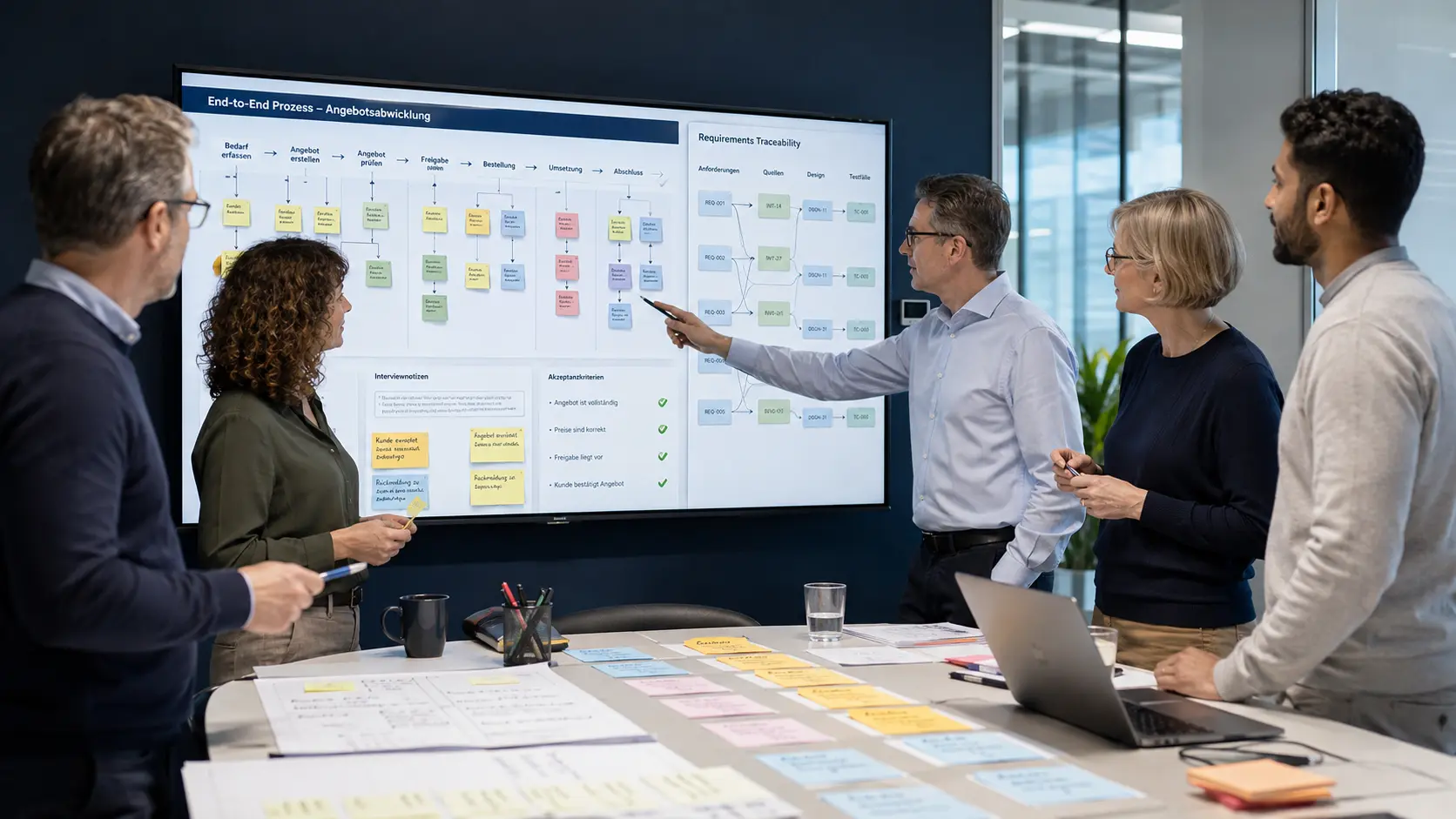
Structure stakeholders, objectives, system boundaries and requirements using suitable elicitation, modelling and documentation techniques. Quality criteria, acceptance conditions, reviews and traceability connect business and delivery.
Derive architecture goals from business and quality requirements and structure components, interfaces and responsibilities. Architecture decisions, risks, modernisation steps and transparent documentation are assessed together.
Transform business concepts and rules into conceptual, logical and relational data models. Keys, relationships, normalisation, integrity, SQL queries and performance are treated as connected design decisions.
Design the path from source to target systems with mappings, transformations, loading approaches and quality rules. Delta logic, error handling, restart, monitoring, metadata and lineage are considered from the start.
Capture functions, data, interfaces, dependencies, documentation and implicit knowledge in an established solution. Risks and unknown areas become visible so modernisation can proceed incrementally without uncontrolled changes to current behaviour.
Practical module with explanation, exercise, reflection and a reusable transfer result.
Work with Oracle-specific SQL and PL/SQL from data access and transactions to procedures, functions and packages. Exception handling, performance, testing, interfaces and maintainability are connected through realistic database tasks.
Practical module with explanation, exercise, reflection and a reusable transfer result.
Source, requirement, design, change, test, approval and release are linked so decisions and effects remain explainable.
The method is practised with SQL, PL/SQL, MySQL/MariaDB, PHP, JSON, HTML, CSS, JavaScript, SQL*Plus and Bash without turning the seminar into ten isolated language courses.
Normal cases, edge cases, side effects and unacceptable outcomes are translated into verifiable tests, regression checks and approval criteria.
Release preparation, configuration, scripts, handover, monitoring, fallback and maintenance effects are treated as one operational process.
Observations, logs, reproduction steps, hypotheses and counterchecks are separated so plausible AI explanations are not mistaken for verified findings.
Decisions, assumptions, interfaces, operating notes, open risks and validation evidence are documented clearly and maintainably.
Affected components, data, interfaces, existing logic and possible side effects are identified and included in validation before change.
AI provides working drafts. People define goals and boundaries, review evidence and tests, decide on correction and approve further use.
An anonymised case shows how requirements, database, PHP, web technology, testing, installation and documentation are iteratively supported by AI and professionally approved.
Oracle SQL and PL/SQL context, data models, transactions, packages, failure modes, test data, reporting and documentation are treated together rather than in isolation.
Direct entry points
Three seminars to get started
Foundations, prompting and productive knowledge work – transparently described and directly comparable.
Live online seminar
Lateral leadership: leading without formal authority
In plain language Lead people and projects without being their manager
Show content and terminology
Lateral leadership means providing orientation and enabling collaboration when team members do not report to you. This seminar combines established leadership tools with enterprise IT, project and responsible skipper experience.
Technical terms you will learn Lateral leadership, stakeholders, mandate, role clarity, briefing, debriefing, decision-making, conflict clarification, commitment
- Clarify role, assignment and mandate
- Understand stakeholders and interests
- Communicate clearly at eye level
Learning formats
The right format for your goal
From a focused introduction to collaborative work on your specific challenge.
Entry & orientationWebinar or keynote
Development through dialogueLive online or in-house
Application & coachingIn person or aboard HERA
Recorded webinars
Use substantial content at your own pace and revisit it whenever needed.
Explore format Development through dialogueLive exchangeLive online seminars
Personally facilitated, open to questions and without travel.
Explore format Application & coachingTogether in personIn-person seminars
Focused learning in small groups with room for exchange and application.
Explore format Entry & orientationA clear impulseTalks & keynotes
Substantive perspective for organisations, leadership teams and events.
Explore format Development through dialogueFor your organisationIn-house training
Content, examples and pace aligned with your assignment and your team.
Explore format Application & coachingA distinctive meeting pointAcademy aboard HERA
A distinctive meeting point for small groups, clear thinking and focused work.
Explore format
How we work
We explain. We meet you where you are. We help you take action.
AI is not an end in itself. What matters is whether people understand it, use it responsibly and solve real tasks more effectively.
- Clear without being simplistic: We translate technology without losing the relationships that matter.
- At eye level: We start with your knowledge, your processes and your specific questions.
- Questions welcome: Questions are explicitly encouraged, because effective learning grows through dialogue.
An academy that enables learning
We do not merely repeat terminology. We make it usable.
More than 25 years of adult education and thousands of participants in IT and Oracle topics shape our approach: explain clearly, practise together, review critically and transfer safely.
We connect new terminology immediately with plain language and a familiar problem.
You apply the method yourself using a clear example and can ask questions at any time.
We compare results, identify errors and develop understandable quality criteria.
You leave with a template, decision aid or a concrete next step for your work.
Expertise and sectors
Build knowledge where it matters to your practice.
From AI and databases to architecture, requirements engineering and legacy systems: choose a technical entry point or your sector. We connect both with your real challenges.
Areas of expertise
Technical and methodological expertise, explained clearly and translated into reliable practice.
Area of expertiseAI & Knowledge EngineeringBuild AI on reliable data, processes and knowledge structures.Explore topic
Area of expertiseDatabases & Data IntegrationDesign reliable data models, interfaces and data flows.Explore topic
Area of expertiseSoftware Architecture & ModernisationDesign established and new systems as a reliable whole.Explore topic
Area of expertiseRequirements & Business AnalysisUnderstand needs, refine requirements and make decisions transparent.Explore topic
Area of expertiseProject Delivery & ImplementationMake complex initiatives technically and organisationally manageable.Explore topic
Area of expertiseQuality & TestingSecure quality from requirements through production operations.Explore topic
Area of expertiseLeadership & collaborationTake responsibility, communicate clearly and keep teams capable of action without unnecessary hierarchy.Explore topic Expertise with a personal touch
Instructors who know what they are doing and keep your learning success in focus.
Experience is not measured by the number of technical terms used. It shows in attentive listening, the right questions and knowledge delivered in a way that truly reaches the client.

The first step
Where should AI make a practical difference for you?
You do not need to know the solution yet. Tell us about the task. We will assess it, explain the options and develop a sensible next step with you.