
Live online seminar · AI & Knowledge Engineering
Enterprise AI: organisational knowledge, RAG and data integration
In plain language Create reliable AI answers from your own documents and data
Make organisational knowledge discoverable, useful and controlled.
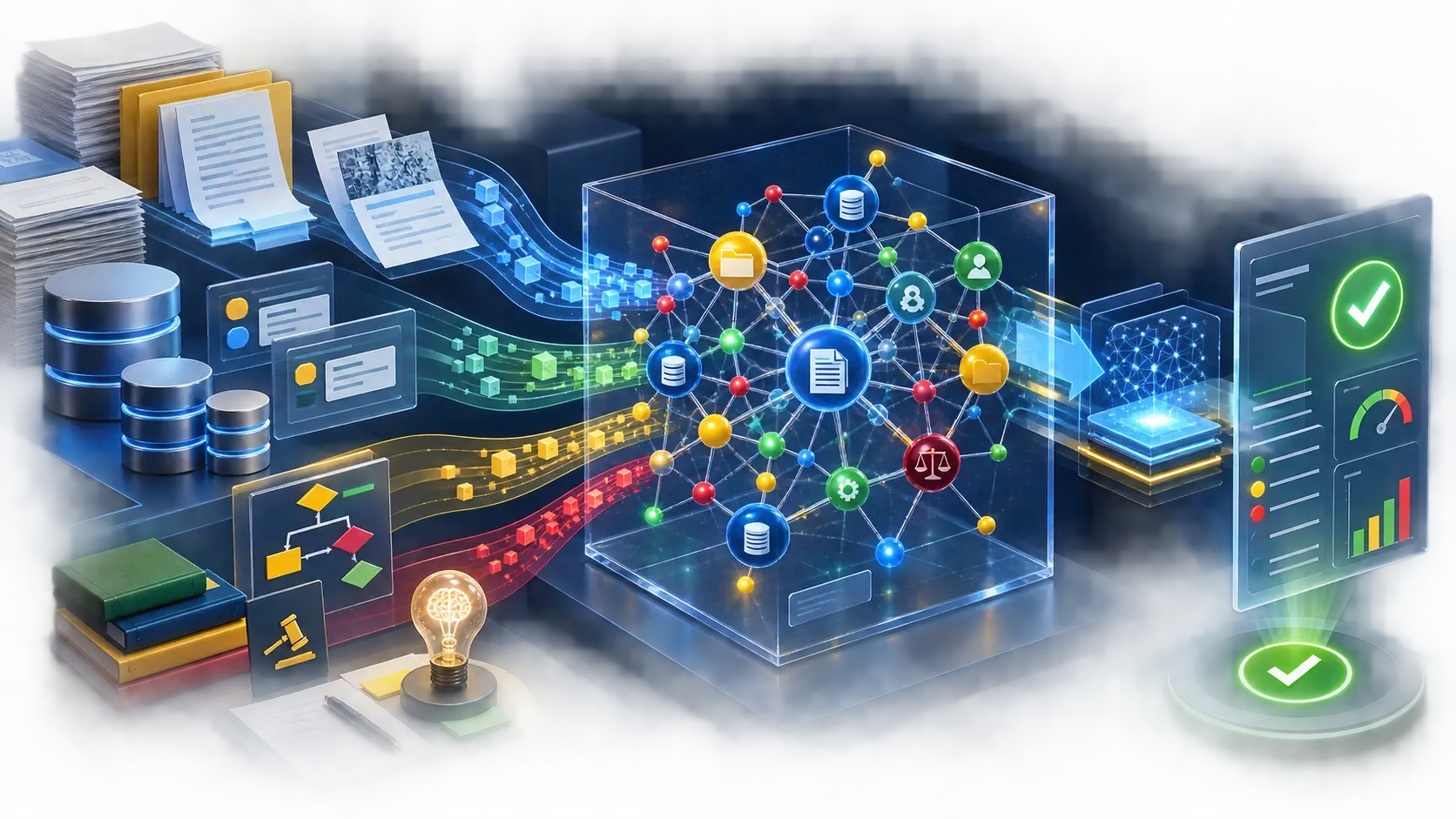
RAG means that AI first searches approved enterprise sources and then formulates an answer grounded in the available knowledge.
Technical terms you will learnRetrieval-Augmented Generation (RAG), Embeddings, Vektorsuche, Quellenbezug, Knowledge Engineering
Duration2 days
FormatLive online seminar
Price1,450.00 €1,725.50 € incl. 19% VAT
Reliably planned
What is included with this seminar
Current market-standard content is included as a matter of course. CTPM+ makes the transfer to your IT, data and process practice visible.
Your learning pathEvery seminar works as a standalone offer. The highlighted stage shows its position; advanced learning can follow as needed.
- 01EntryBuild sound foundations
- 02ApplicationApply methods in practice
- 03SpecialisationDeepen roles and systems
- 04Transfer & coachingImplement a concrete result
Delivery
Choose the right format
Compare delivery, duration, price and configuration. In-person and in-house formats are aligned with your group, location and assignment.
Live online seminar
Request & confirmationLive online seminar · 2 days
Two days covering RAG, knowledge, data sources, architecture and pilot planning.
- Duration
- 2 days
- Level
- Professional
- Location
- Online
Next live dates
CTPM+ is included in the seminar price.
Ask about availabilityOpen in-person seminar
Request & confirmationIn-person seminar · tailored
Content, examples, duration and transfer are tailored to the audience and assignment.
- Duration
- By arrangement
- Level
- Professional
- Location
- Academy venue
Duration, scope and price are proposed after professional scoping.
Ask about availabilityIn-house training
Request & confirmationIn-house training · client-specific
Content, examples, systems and priorities are prepared with the client.
- Duration
- By arrangement
- Level
- Professional
- Location
- At the client site
Duration, scope and price are proposed after professional scoping.
Ask about availabilityLearning content
What you will work on in this seminar
The modules make scope, priorities and intentional boundaries transparent.
Planned learning scope: 2 days. The offered format covers 2 days, including breaks, questions and transfer phases.
Everything considered market standard today is naturally included.CTPM+ describes what makes our seminar additionally valuable.
Distinguish market standard and CTPM+Show or hide each value class separately.
From understanding to your own result
Select a learning module to see its content and practical value explained clearly.
Market standard
CTPM+
UnderstandTerms and relationships
ApplyPractise methods
TransferRelate to role and workflow
ResultTake away a concrete result
Current models, tools & applications
Distinguish language models, AI services, copilots and specialised tools by task, data access and degree of integration. Criteria such as output quality, data protection, cost, currency and integration into existing workplaces make selection transparent.
Suggested seminar agendaBuilt from this delivery’s learning modules
- Current models, tools & applications70 minutes
- Capabilities, limits & common failure modes70 minutes
- Review & optimise results80 minutes
- Confidential information & organisational data80 minutes
- Use documents & knowledge systematically150 minutes
- Databases, interfaces, ETL & enterprise software140 minutes
- Quality & control points120 minutes
- Adaptation to audience, knowledge & assignment
- Data modelling, SQL & databases130 minutes
The sequence may be adapted to the group, prior knowledge and questions; the stated learning outcomes remain binding.
Compare 41 additional modulesThese topics are intentionally not included in this seminar and are shown only for comparison.
Market standardNot included
Systematic prompting
Content and learning objective+
Translate unclear work requests into structured prompts containing context, task, inputs, objective, quality criteria and output format. This makes requirements transparent, results easier to compare and follow-up questions more focused.
Market standardNot included
Improve & reuse prompts
Content and learning objective+
Improve prompts in controlled steps, compare variants and distinguish professional weaknesses from wording or context problems. Proven patterns are versioned, documented and made reusable for similar tasks.
Market standardNot included
Text, documents, research & knowledge work
Content and learning objective+
Work on common tasks such as drafting, summarising, comparing, extracting, classifying and preliminary research. Clarify required inputs, result validation and where AI usefully supports the existing workflow.
Market standardNot included
Practical examples & exercises
Content and learning objective+
Apply the methods to transparent tasks, compare alternative approaches and reflect on the impact of your decisions. Exercises combine explanation, hands-on work, feedback and a transferable improvement.
Market standardNot included
Course materials & job aids
Content and learning objective+
Receive and use checklists, structures, examples and concise references that remain useful after the seminar. Materials are not merely distributed; they are explained and related to common application situations.
CTPM+Not included
Workflows & process chains
Content and learning objective+
Map a real workflow with triggers, inputs, roles, decisions, handovers and outputs. Assess where AI can help, which controls are required and how a reliable pilot fits into the process chain.
CTPM+Not included
Enterprise IT & project cases
Content and learning objective+
Work on realistic cases from requirements engineering, business analysis, project management, development, architecture, quality and testing. Roles, system dependencies, trade-offs and technical constraints are explicitly included.
CTPM+Not included
Reusable prompt, analysis & workflow templates
Content and learning objective+
Develop prompt structures, analysis templates and workflow patterns that can be reused with clear inputs, checks and ownership. Versioning and adaptation prevent templates from becoming uncontrolled one-off solutions.
CTPM+Not included
Concrete transfer result
Content and learning objective+
Create a tangible result for your own work, such as a prompt template, analysis, checklist, process sketch or pilot description. Next steps, ownership and success criteria make the transfer actionable.
CTPM+Not included
Collaboration with sector experts
Content and learning objective+
For regulated, safety-critical or highly specialised content, the roles and responsibilities of a dual-instructor team are defined. CTPM covers AI, IT, data, architecture and methodology; the sector expert adds processes, terminology and binding requirements.
Market standardNot included
Requirements engineering & business analysis
Content and learning objective+
Structure stakeholders, objectives, system boundaries and requirements using suitable elicitation, modelling and documentation techniques. Quality criteria, acceptance conditions, reviews and traceability connect business and delivery.
Market standardNot included
Software architecture & modernisation
Content and learning objective+
Derive architecture goals from business and quality requirements and structure components, interfaces and responsibilities. Architecture decisions, risks, modernisation steps and transparent documentation are assessed together.
Market standardNot included
ETL, interfaces & data integration
Content and learning objective+
Design the path from source to target systems with mappings, transformations, loading approaches and quality rules. Delta logic, error handling, restart, monitoring, metadata and lineage are considered from the start.
CTPM+Not included
Legacy analysis & knowledge retention
Content and learning objective+
Capture functions, data, interfaces, dependencies, documentation and implicit knowledge in an established solution. Risks and unknown areas become visible so modernisation can proceed incrementally without uncontrolled changes to current behaviour.
Market standardNot included
Understand relational databases
Content and learning objective+
Practical module with explanation, exercise, reflection and a reusable transfer result.
Market standardNot included
Select, filter and sort data
Content and learning objective+
Practical module with explanation, exercise, reflection and a reusable transfer result.
Market standardNot included
Aggregate and group data
Content and learning objective+
Practical module with explanation, exercise, reflection and a reusable transfer result.
Market standardNot included
Join tables safely
Content and learning objective+
Practical module with explanation, exercise, reflection and a reusable transfer result.
Market standardNot included
Classify data changes safely
Content and learning objective+
Practical module with explanation, exercise, reflection and a reusable transfer result.
Market standardNot included
Distinguish standard SQL, Oracle, MySQL and MariaDB
Content and learning objective+
Practical module with explanation, exercise, reflection and a reusable transfer result.
CTPM+Not included
Translate business questions into SQL
Content and learning objective+
Practical module with explanation, exercise, reflection and a reusable transfer result.
CTPM+Not included
Validate results technically and functionally
Content and learning objective+
Practical module with explanation, exercise, reflection and a reusable transfer result.
Market standardNot included
Oracle SQL & PL/SQL
Content and learning objective+
Work with Oracle-specific SQL and PL/SQL from data access and transactions to procedures, functions and packages. Exception handling, performance, testing, interfaces and maintainability are connected through realistic database tasks.
Market standardNot included
Clarify role, assignment and mandate
Content and learning objective+
Practical module with explanation, exercise, reflection and a reusable transfer result.
Market standardNot included
Understand stakeholders and interests
Content and learning objective+
Practical module with explanation, exercise, reflection and a reusable transfer result.
Market standardNot included
Communicate clearly at eye level
Content and learning objective+
Practical module with explanation, exercise, reflection and a reusable transfer result.
Market standardNot included
Prepare and represent decisions
Content and learning objective+
Practical module with explanation, exercise, reflection and a reusable transfer result.
Market standardNot included
Address resistance and conflict early
Content and learning objective+
Practical module with explanation, exercise, reflection and a reusable transfer result.
Market standardNot included
Create commitment without hierarchy
Content and learning objective+
Practical module with explanation, exercise, reflection and a reusable transfer result.
CTPM+Not included
Use briefing and debriefing effectively
Content and learning objective+
Practical module with explanation, exercise, reflection and a reusable transfer result.
CTPM+Not included
Lead under uncertainty and secure transfer
Content and learning objective+
Practical module with explanation, exercise, reflection and a reusable transfer result.
Market standardNot included
End-to-end traceability from requirements to release
Content and learning objective+
Source, requirement, design, change, test, approval and release are linked so decisions and effects remain explainable.
Market standardNot included
AI-assisted implementation across technology stacks
Content and learning objective+
The method is practised with SQL, PL/SQL, MySQL/MariaDB, PHP, JSON, HTML, CSS, JavaScript, SQL*Plus and Bash without turning the seminar into ten isolated language courses.
Market standardNot included
Testing, regression and release gates
Content and learning objective+
Normal cases, edge cases, side effects and unacceptable outcomes are translated into verifiable tests, regression checks and approval criteria.
Market standardNot included
Deployment, operations and maintenance
Content and learning objective+
Release preparation, configuration, scripts, handover, monitoring, fallback and maintenance effects are treated as one operational process.
Market standardNot included
Technical error analysis and debugging
Content and learning objective+
Observations, logs, reproduction steps, hypotheses and counterchecks are separated so plausible AI explanations are not mistaken for verified findings.
Market standardNot included
Technical documentation and handover
Content and learning objective+
Decisions, assumptions, interfaces, operating notes, open risks and validation evidence are documented clearly and maintainably.
CTPM+Not included
CTPM+: system context, dependencies and side effects
Content and learning objective+
Affected components, data, interfaces, existing logic and possible side effects are identified and included in validation before change.
CTPM+Not included
CTPM+: controlled human-in-the-loop workflow
Content and learning objective+
AI provides working drafts. People define goals and boundaries, review evidence and tests, decide on correction and approve further use.
CTPM+Not included
CTPM+: Academy case – from requirement to verified patch
Content and learning objective+
An anonymised case shows how requirements, database, PHP, web technology, testing, installation and documentation are iteratively supported by AI and professionally approved.
CTPM+Not included
CTPM+: Oracle code, error analysis, reporting and documentation
Content and learning objective+
Oracle SQL and PL/SQL context, data models, transactions, packages, failure modes, test data, reporting and documentation are treated together rather than in isolation.
The complete professional standard
Fundamentals, current tools, prompting, exercises, output review, privacy, security and responsible use are taught clearly and practically.
More transfer through senior practice
CTPM+ connects learning to roles, documents, knowledge, processes, data, interfaces, architecture and a realistic next implementation step.
An academy that enables learning
We do not merely repeat terminology. We make it usable.
More than 25 years of adult education and thousands of participants in IT and Oracle topics shape our approach: explain clearly, practise together, review critically and transfer safely.
Understand
We connect new terminology immediately with plain language and a familiar problem.
Practise
You apply the method yourself using a clear example and can ask questions at any time.
Review
We compare results, identify errors and develop understandable quality criteria.
Transfer
You leave with a template, decision aid or a concrete next step for your work.
Two learning samples from this seminar
Technical terms become clear step by step
Open an example to see how we connect terminology with meaning, application and review.
RAGHow AI accesses approved enterprise knowledge
Retrieval-augmented generation first searches selected documents or data sources and then lets the language model formulate an answer grounded in those sources.
Context windowWhich information the model actually considers
The context window is the model’s working area for the current task. You learn what belongs there and how long or unstructured input can displace important information.
For seminars with practical transfer
Example transfer result
A practical, reviewed result for applying the seminar content to your own work: Mit KI verlässliche Antworten aus eigenen Dokumenten und Daten gewinnen.
The actual result is adapted to the participants’ task, role and permitted data during the seminar.What you will gain
Explain RAG clearly and accurately.
Assess data and document sources.
Design a target architecture.
Define quality, security and pilot criteria.
Assess data and document sources.
Design a target architecture.
Define quality, security and pilot criteria.
What this live online seminar covers
The seminar moves from knowledge needs through documents, metadata and retrieval to model answers, source grounding and operations. CTPM+ connects knowledge engineering with data modelling, databases, interfaces, ETL, permissions and enterprise architecture.Participants
IT leaders, architects, data engineers, knowledge managers, business owners and enterprise AI project managers.
Included
Two-day seminar, architecture models, data and quality checks, RAG canvas and pilot planning.
Prerequisites
AI fundamentals plus a basic understanding of data, systems or document management.
Not included
No guaranteed product selection, production RAG build or binding security assessment.